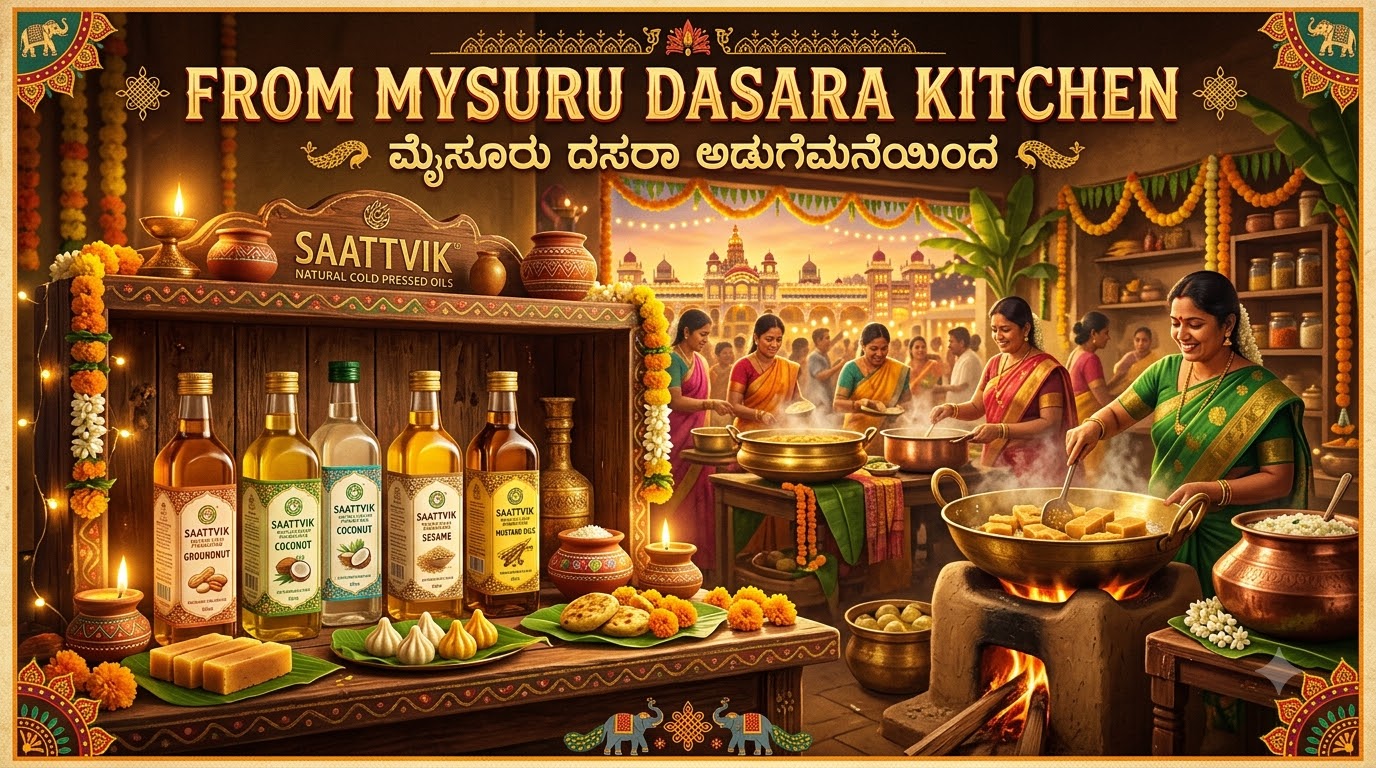
For ten days every year, Mysuru becomes the heart of Karnataka. The palace glows with lights, Chamundeshwari is worshipped, and the Jamboo Savari winds through the city on Vijayadashami. Mysuru Dasara is our Nadahabba, the state festival.
Inside Karnataka homes, the real celebration happens in the kitchen. Bombe Habba steps need snacks for visiting guests. Each day's naivedya has to be ready before pooja. Ayudha Pooja calls for a full spread, and Vijayadashami ends with a festive oota.
Behind every one of these dishes is a choice most of us make without thinking: which enne?
Traditional Karnataka kitchens never relied on a single oil. Each had its own role.
| Oil | Kannada name | Traditionally used for |
|---|---|---|
| Groundnut oil | Kadalekai enne | Deep-frying chakkuli, kodubale, nippattu, kajjaya |
| Sesame oil | Ellenne | Deepa (lamps), obbattu dough, puliyogare, chutney pudi |
| Coconut oil | Kobbari enne | Tempering usli and kosambari, coastal and Malnad dishes |
| Niger seed oil | Huchellu enne | North Karnataka dishes and chutneys |
Kadalekai enne is the frying workhorse. It holds up well through long batches of deep-frying, which is exactly what Bombe Habba snack-making demands.
Ellenne is the oil of the pooja room. It lights the deepa through all nine nights, and it gives obbattu dough its soft, pliable texture.
Kobbari enne brings the aroma to a simple usli (sundal) offered as naivedya, with a tempering of mustard, curry leaves and grated coconut.
Our grandparents bought oil from the gaana (the traditional wooden press) and judged it by smell. Today, look for three things:
At Saattvik Natural, every batch is cold-pressed and lab-tested, and we are happy to share the report. FSSAI NO. 21225117000081
Which oil is best for frying Dasara snacks like chakkuli?
Kadalekai enne (groundnut oil) is the traditional choice in Karnataka because it holds up well in deep-frying.
Which oil is used for the deepa during Navaratri?
Ellenne (sesame oil) is the most traditional choice for lighting pooja lamps.
Is cold-pressed oil the same as ganada enne?
Ganada enne refers to oil from a traditional wooden press. Cold-pressed oil is extracted without external heat, which keeps the seed's natural aroma.
Order your Dasara oils on WhatsApp → [link]
Festive packs are available for families, apartments and corporate gifting.
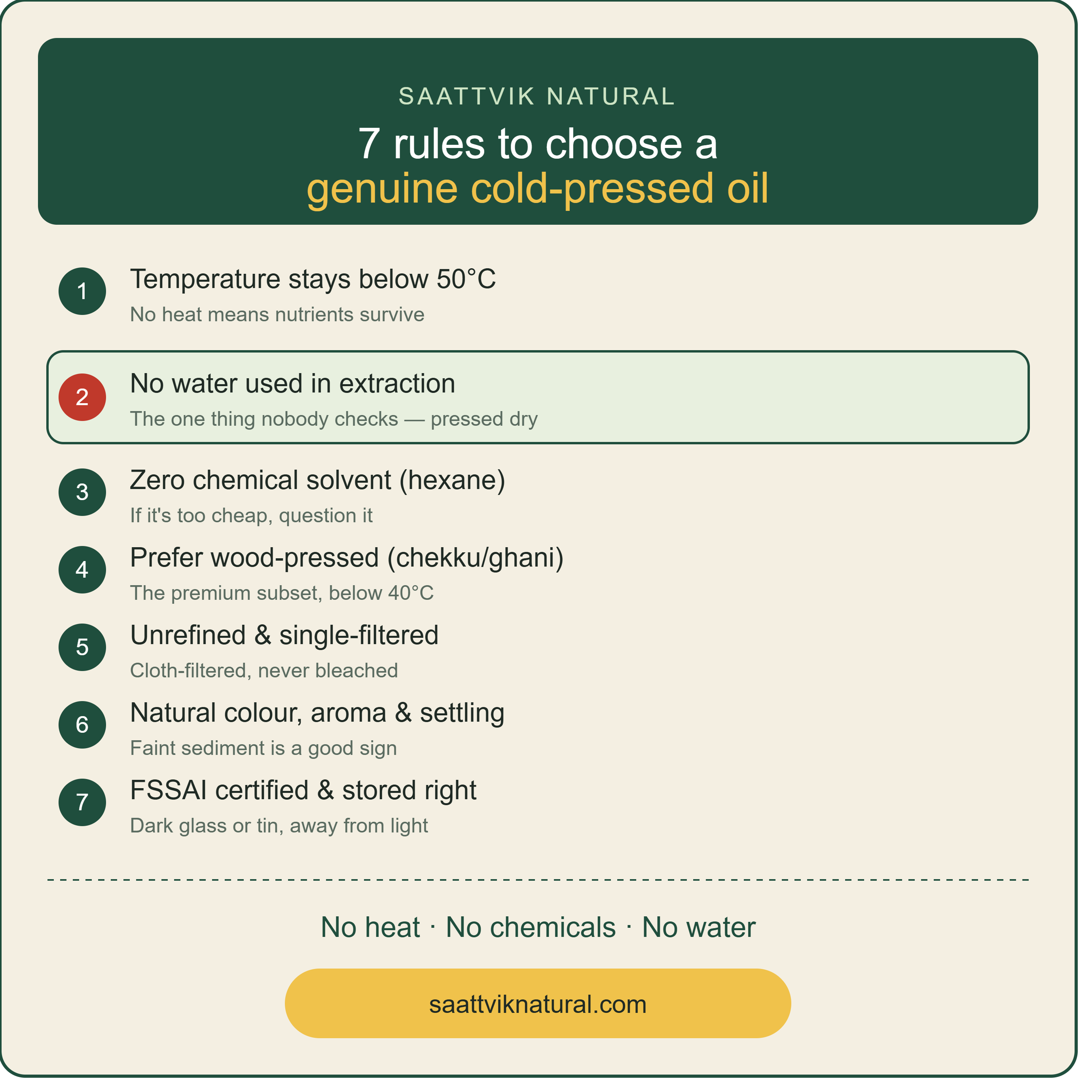
<p>To choose a genuinely cold-pressed edible oil, verify four things — the extraction temperature stays below 50°C, no chemical solvent (hexane) is used, no water is added during extraction, and the oil is single-filtered and unrefined. The purest options are wood-pressed (chekku/ghani) oils, which stay below 40°C and retain the most nutrients.</p><p>Cold-pressed oil labels in India have never been more confusing. “Wood-pressed,” “kachi ghani,” “expeller-pressed,” “cold-pressed,” “filtered” — the terms overlap and marketing blurs them. This guide gives you seven clear rules to pick the real thing, including one most buyers never check: <strong>whether water was used in extraction.</strong></p><p> </p><p>#ColdPressedOil #ChekkuOil #WoodPressedOil #SaattvikNatural #HealthyCookingOil #FSSAICertified #NoChemicals #KachiGhani #CookingOilIndia #CleanEating #GroundnutOil #SesameOil #HexaneFree #TraditionalOil #EdibleOil</p>
Read More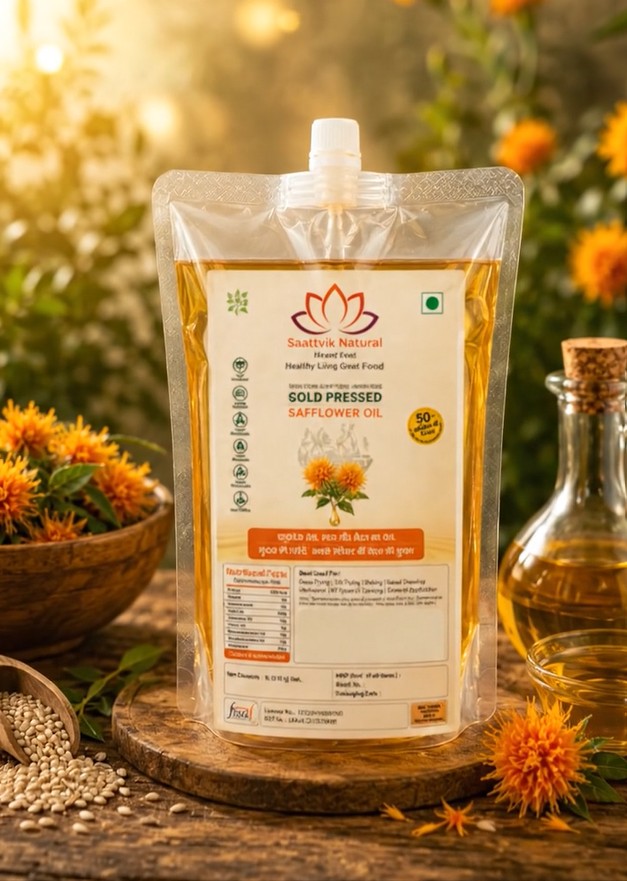
<h3>Discover how cold-pressed safflower oil compares to olive oil in heart health, antioxidants & smoke point. Pure, chemical-free oil from Saattvik Natural.</h3><h2> </h2>
Read More
Refined oils go through heat and chemical processing that strips away nutrients. Here is why cold-pressed, wood-pressed oils retain more of what your body actually needs.
Read More